Everything you need to know before placing your first bulk order — from key features and customization options to quality assurance and supplier selection.
The market for digital display products has grown steadily over the past decade, and at the center of this growth is the
wifi digital photo frame — a device that has evolved from a simple slideshow player into a connected, cloud-synced smart display. Whether you are a retailer looking to expand your product line, a corporate buyer sourcing promotional gifts, or a brand owner launching a private-label electronics line, knowing how to identify a trustworthy manufacturing partner can make the difference between a successful product launch and a logistical headache.
This guide walks you through the essential factors to consider when sourcing WiFi digital photo frames and related digital display products directly from a factory, with practical insights drawn from real-world manufacturing experience.
What Makes a WiFi Digital Photo Frame Stand Out
Not all digital photo frames are created equal. A quality WiFi-enabled frame should offer more than just a screen and a power cord. Here are the features that separate a premium product from a basic one:
IPS display technology that maintains color accuracy and brightness from wide viewing angles, so photos look vivid whether viewed head-on or from across the room.
Touch screen capability — increasingly common in mid-range and high-end frames — which makes navigating menus and photo galleries intuitive for users of all ages.
Cloud-based photo sharing via dedicated mobile apps. The most popular solution today is FRAMEO, which allows family members to send photos and videos directly to the frame from anywhere in the world using a smartphone.
Adequate built-in storage — typically 16GB or 32GB — supplemented by SD card and USB drive support for offline photo playback.
A range of sizes to suit different use cases: compact 8-inch models for bedside tables, popular 10.1-inch versions for living rooms, and large 15.6-inch or 21.5-inch displays for wall-mounted installations.
When you buy from a retailer or a middleman, you are paying a markup that covers their own sourcing, warehousing, and profit margins. Going directly to a factory eliminates those extra layers. But the real advantage of working with a factory goes deeper than price.
A factory with 18 years of OEM experience — like Shenzhen SSA Electronic Co., Ltd. — brings engineering knowledge that generic trading companies simply cannot match. They understand component sourcing, PCB design, firmware development, and assembly processes at a granular level. This means they can troubleshoot issues before they become problems and offer practical suggestions for improving your product.
Key advantage: A factory-based supplier can offer four levels of customization: function customization (adding or modifying software features), software customization (branded apps, custom UI, pre-installed software), appearance customization (custom molds, colors, materials, and branding), and package customization (custom packaging design with your brand logo). This level of flexibility is rarely available from distributors.
The FRAMEO Ecosystem: A Standard Worth Demanding
If you are sourcing WiFi photo frames for resale, one feature consistently ranks as the most requested by end users: FRAMEO compatibility. A
FRAMEO cloud frame allows users to send photos and short videos (up to 15 seconds) to the frame instantly via the FRAMEO app, available for both iOS and Android. The app supports multiple senders, making it ideal for families spread across different cities or countries.
FRAMEO has become the de facto standard for WiFi photo frames because it is platform-agnostic, regularly updated, and designed with privacy in mind — photos are encrypted during transfer. When evaluating a supplier, confirm that their FRAMEO-integrated frames are officially licensed and run the latest version of the FRAMEO software. Unlicensed integrations can lead to compatibility issues and poor user reviews, which directly affect your return rates and brand reputation.
Beyond FRAMEO, some manufacturers also offer frames compatible with alternative apps like Biu Frame or integrate voice control via Alexa, giving you more options to differentiate your product line.
Beyond Photo Frames: Expanding Your Product Portfolio
A well-established factory typically manufactures more than just one product category. If you are already sourcing WiFi photo frames, consider diversifying your catalog with complementary products from the same supplier. This simplifies logistics, strengthens your negotiating position, and ensures consistent quality across your product line.
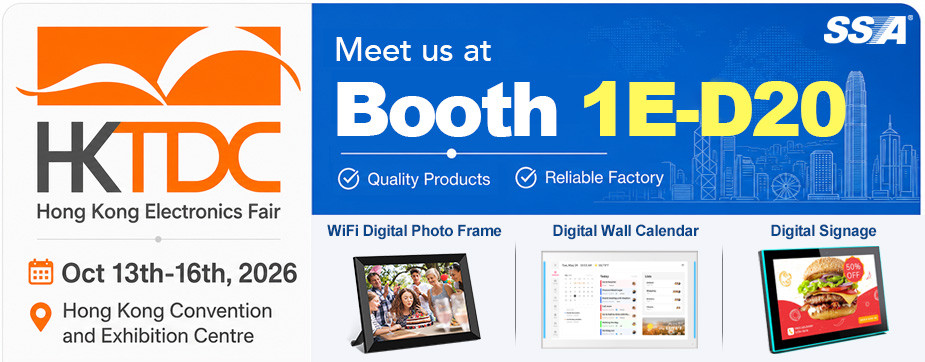
For instance, SSA Electronics also produces digital calendars in sizes ranging from 10.1 inches to 32 inches — smart displays that replace traditional paper calendars and sync family schedules via cloud apps. These are increasingly popular for kitchen walls, family command centers, and office meeting rooms.
Another growing category is
digital signage for commercial use. From 10.1-inch meeting room booking tablets and L-shaped desktop displays for retail counters to 43-inch floor-standing kiosks, a capable
digital signage supplier can provide Android-based all-in-one solutions for restaurants, hotels, banks, hospitals, and corporate lobbies. Medical-grade tablets with antimicrobial housings are also available for healthcare environments.
Other product lines worth exploring include mini projectors (Android-powered portable models), kids' tablets with pre-installed educational apps and parental controls, portable monitors for laptop users and gamers, acrylic motion video frames for NFT art and dynamic displays, and video brochures for corporate marketing and special events. Sourcing multiple categories from one factory reduces your supplier management overhead and often unlocks volume-based pricing advantages.
How to Evaluate a Factory's Quality Control System
A factory's quality control process is what protects your business from defective products, customer complaints, and costly returns. Before placing an order, ask the following questions:
Do they conduct incoming quality control (IQC) on components and raw materials before production begins?
Is there an in-process quality control (IPQC) checkpoint during assembly to catch defects early?
What does their final quality control (FQC) process look like before shipment — do they test every unit or use statistical sampling?
What certifications do they hold? Common ones include CE, FCC, RoHS, and REACH. For medical-grade products, additional certifications apply.
Do they have a dedicated after-sales team with English-speaking engineers who can provide technical support to your customers?
A factory that has been serving clients in over 50 countries for nearly two decades has likely refined its quality systems through years of real-world feedback. Longevity in this industry is a meaningful signal — it means the factory has consistently met international standards and maintained relationships with repeat buyers.
The OEM/ODM Process: What to Expect
If you are new to OEM/ODM manufacturing, understanding the typical workflow helps set realistic expectations. The process generally follows these stages:
Requirement gathering: You share your specifications — target market, desired features, screen size, budget range, and branding requirements. The factory's engineering team reviews feasibility and provides feedback.
Sample development: The factory produces a pre-production sample for your evaluation. This is your opportunity to test the product, review the build quality, and request adjustments.
Customization implementation: Once the sample is approved, the factory applies your branding — this can include a custom boot logo, branded packaging, a custom UI theme, pre-installed apps, and even custom mold designs for unique product shapes.
Mass production and quality inspection: Production runs through the factory's QC checkpoints. Many buyers arrange third-party inspection before shipment for additional peace of mind.
Shipping and after-sales: The factory handles logistics (FOB, CIF, or DDP depending on your agreement) and provides ongoing technical support through their after-sales department.
Common Pitfalls to Avoid When Sourcing Digital Display Products
Even experienced buyers make mistakes when sourcing electronics. Here are a few pitfalls to watch out for:
Choosing based on price alone: The lowest quote often comes with compromises — cheaper LCD panels with poor viewing angles, underpowered processors that feel sluggish, or outdated WiFi modules with unstable connections. These issues lead to negative reviews and returns that cost far more than the initial savings.
Ignoring software stability: Hardware specifications are easy to compare, but software quality is harder to evaluate from a spec sheet. A frame with great hardware but buggy firmware will frustrate users. Ask about software update policies and test the interface thoroughly on a sample unit.
Overlooking packaging requirements: If your products will be sold on Amazon or shipped individually to end customers, the packaging must withstand the rigors of courier handling. A factory that also offers custom packaging design can help you create retail-ready boxes that protect the product and present your brand professionally.
Not verifying certifications: Different markets have different regulatory requirements. The EU requires CE marking, the US requires FCC compliance, and many retailers require RoHS and REACH certification. Confirm that your supplier can provide valid certificates for your target markets before production begins.
Making the Right Choice for Your Business
The digital display market continues to expand, driven by demand for connected home devices, commercial digital signage solutions, and personalized tech gifts. Whether you are entering the market for the first time or expanding an existing product line, the supplier you choose will shape your customer experience, your brand reputation, and your bottom line.
Look for a manufacturer with a proven track record — one that has been in the industry long enough to have weathered multiple technology cycles and market shifts. Verify their quality control processes, ask about their customization capabilities, and test their communication responsiveness during the inquiry stage. A supplier that responds promptly and clearly to your questions before you place an order is likely to be reliable when issues arise after delivery.
With the right manufacturing partner, you can bring high-quality WiFi digital photo frames, digital calendars, commercial signage displays, and a range of complementary products to your market — backed by professional engineering support and consistent quality assurance.
Looking for a reliable manufacturing partner? Shenzhen SSA Electronic Co., Ltd. has been producing digital photo frames, digital signage, and smart display products for over 18 years, serving clients in more than 50 countries. With full OEM/ODM customization capabilities, a rigorous quality control system, and a dedicated after-sales engineering team, SSA is equipped to help you bring your product vision to market. Contact their team at
sales@ssa-digital.com or visit
www.ssa-digital.com to explore their product catalog and discuss your requirements.